
Running is more than just putting one foot in front of the other. It’s a complex movement pattern that demands strength, coordination, and stability from your entire body to perform efficiently and safely.

Whether you’re a beginner lacing up for your first 5K or a seasoned marathoner chasing a personal record, stability progressions form the foundation of injury-free running and improved performance. These exercises strengthen the often-overlooked stabilizer muscles that keep your body aligned, balanced, and powerful with every stride.
🏃 Why Stability Matters More Than You Think
When most runners think about improving their performance, they focus on logging more miles or running faster intervals. While training volume and intensity certainly matter, they overlook a crucial component: stability. Your body’s ability to maintain proper alignment and control during the dynamic, repetitive motion of running directly impacts your efficiency, speed, and injury resilience.
Every time your foot strikes the ground, your body absorbs forces equivalent to 2-3 times your body weight. Without adequate stability, these forces can’t be properly distributed, leading to compensation patterns that stress joints, tendons, and ligaments. Over time, these imbalances manifest as common running injuries like IT band syndrome, plantar fasciitis, runner’s knee, and stress fractures.
Stability training addresses these vulnerabilities by strengthening the smaller, often neglected muscles that work as stabilizers. These include the hip abductors and adductors, deep core muscles, ankle stabilizers, and the intrinsic foot muscles. When these stabilizers function optimally, they create a solid foundation that allows your prime movers to generate power more effectively.
The Foundation: Understanding Running-Specific Stability
Running stability differs significantly from general balance or strength. It requires your body to maintain alignment and control while moving through single-leg stance phases at various speeds. Unlike static balance exercises, running stability training must prepare your neuromuscular system for the dynamic, repetitive nature of running.
The key components of running stability include hip stability, core control, ankle stability, and foot strength. Each of these elements works synergistically to create efficient, injury-resistant running mechanics. When one component weakens, the entire kinetic chain suffers, forcing other structures to compensate and increasing injury risk.
Hip Stability: The Control Center of Running Mechanics
Your hips serve as the command center for running movement. Strong, stable hips prevent excessive knee valgus (inward collapse), maintain pelvic alignment, and enable powerful push-off with each stride. Weak hip stabilizers, particularly the gluteus medius and gluteus minimus, contribute to some of the most common running injuries.
Hip stability isn’t just about strength—it’s about timing and coordination. Your stabilizer muscles must activate at precisely the right moment during your gait cycle to control your pelvis and femur position. This neuromuscular timing can only be developed through specific, progressive stability exercises.
Essential Stability Progressions: Building Your Foundation
Effective stability training follows a logical progression from basic to advanced, from static to dynamic, and from stable to unstable surfaces. Rushing this progression increases injury risk and limits the neurological adaptations that make stability training effective. Let’s explore the essential progressions every runner should master.
Level 1: Static Stability Exercises
Begin your stability journey with exercises that challenge your balance and control in stationary positions. These foundational movements teach your nervous system to activate stabilizer muscles and maintain proper alignment without the added complexity of movement.
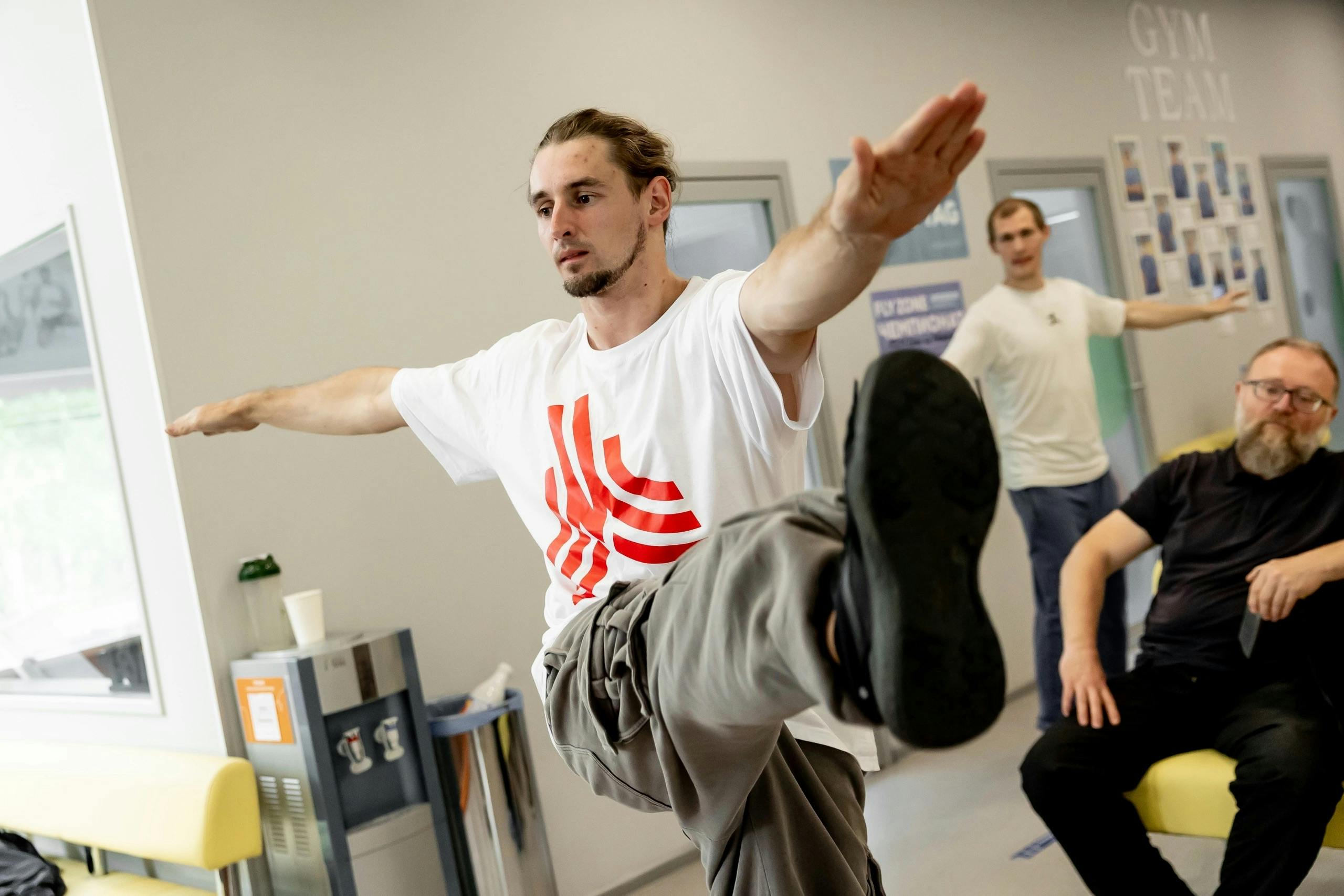
Single-Leg Balance: Stand on one leg for 30-60 seconds, maintaining a level pelvis and engaged core. Progress by closing your eyes, standing on a pillow, or adding small arm movements to increase difficulty.
Hip Hikes: Standing on one leg on a step with the other leg hanging free, lift and lower your free-side hip without tilting your torso. This exercise directly targets the hip abductors crucial for maintaining pelvic stability during running.
Plank Variations: While traditional planks build core strength, side planks specifically challenge the lateral stability system critical for runners. Hold side planks for 30-45 seconds per side, ensuring your body forms a straight line from head to feet.
Level 2: Dynamic Stability Movements
Once you’ve mastered static positions, progress to exercises that incorporate controlled movement while maintaining stability. These exercises more closely mimic the demands of running by challenging your stabilizers through a range of motion.
Single-Leg Deadlifts: This exercise combines hip stability, posterior chain strength, and balance. Stand on one leg, hinge at the hips while extending the opposite leg behind you, then return to standing. Keep your hips level throughout the movement—no rotation or tilting.
Monster Walks: Place a resistance band around your thighs or ankles. Walk forward, backward, and laterally while maintaining tension in the band. This exercise strengthens hip abductors and teaches your body to stabilize while moving.
Single-Leg Squats: Progress from partial range-of-motion pistol squats to deeper variations. Focus on controlling the descent and preventing knee valgus. Use a TRX strap or hold onto support initially if needed.
Level 3: Plyometric Stability Training 💪
Advanced stability training incorporates jumping, hopping, and bounding movements that prepare your stabilizers for the explosive demands of running. These exercises develop reactive strength and train your nervous system to stabilize rapidly during ground contact.
Single-Leg Hops: Hop forward, backward, and laterally on one leg, focusing on sticking each landing with minimal wobbling. Start with small hops and gradually increase distance and speed.
Box Step-Downs: Stand on a box or step, slowly lower one foot toward the ground while maintaining a level pelvis, then return to the starting position. Control is more important than speed—don’t let your hip drop or knee collapse inward.
Lateral Bounds: Jump laterally from one leg to the other, sticking each landing for 2-3 seconds before the next jump. This exercise challenges lateral stability while building power and coordination.
Creating Your Personalized Stability Progression Plan
Implementing stability exercises requires strategic planning to complement your running schedule without causing excessive fatigue. The goal is consistent practice that builds neuromuscular patterns without interfering with your key running workouts.
Frequency and Timing Recommendations
Perform stability exercises 3-4 times per week, ideally after easy runs or on non-running days. These exercises don’t require significant recovery time but work best when your nervous system is fresh enough to maintain proper form and coordination.
Each session should last 15-25 minutes, focusing on quality over quantity. As exercises become easier, progress to the next level rather than simply adding more repetitions. Your nervous system adapts quickly to familiar stimuli, so continuous progression is essential for ongoing improvement.
Integrating Stability Work with Running Training
Avoid performing intensive stability exercises immediately before speed workouts or long runs. However, basic activation exercises like hip hikes and single-leg balance make excellent warm-up activities that prepare your stabilizers for the workout ahead.
Consider this weekly structure for intermediate runners:
- Monday: Easy run + Level 2 stability work (15 minutes)
- Tuesday: Speed workout (include Level 1 activation in warm-up)
- Wednesday: Rest or cross-training + Level 3 stability work (20 minutes)
- Thursday: Tempo run (include Level 1 activation in warm-up)
- Friday: Easy run + Level 2 stability work (15 minutes)
- Saturday: Long run (include Level 1 activation in warm-up)
- Sunday: Rest or Level 1 stability work (10 minutes)
Common Stability Weaknesses and Targeted Solutions
Most runners exhibit predictable patterns of weakness that compromise their stability. Identifying your specific limitations allows you to emphasize the exercises that address your individual needs most effectively.
Trendelenburg Sign: When Your Hip Drops
If your hip drops on the stance leg side during single-leg exercises or running, you’re exhibiting a Trendelenburg sign—a clear indicator of weak hip abductors. This pattern increases stress on the IT band, can cause runner’s knee, and reduces running efficiency.
Target this weakness with: hip hikes, side planks with hip abduction, and lateral band walks. Progress to single-leg deadlifts and lateral bounds once you can maintain a level pelvis during basic exercises.
Knee Valgus: The Inward Collapse
When your knee caves inward during single-leg activities, you’re experiencing knee valgus—a major risk factor for ACL injuries, patellofemoral pain, and IT band syndrome. This compensation often stems from weak hip external rotators combined with poor ankle stability.
Address knee valgus with: clamshells with resistance bands, single-leg squats with mirror feedback, and monster walks emphasizing external rotation. Focus on keeping your knee aligned over your second toe during all exercises.
Ankle Instability: The Forgotten Foundation 🦶
Many runners neglect ankle stability, yet this joint must absorb and redirect enormous forces with every foot strike. Weak ankles lead to compensations up the kinetic chain and increase the risk of ankle sprains and Achilles problems.
Strengthen ankle stability with: single-leg balance on unstable surfaces, alphabet ankle circles while balancing, and toe yoga exercises that activate intrinsic foot muscles. Progress to single-leg hops and jumps as control improves.
Measuring Progress: Are Your Stability Progressions Working?
Tracking your stability improvements requires different metrics than traditional running performance measures. While PR times indicate running fitness, stability gains manifest in movement quality, injury resilience, and efficiency improvements.
Assess your progress using these objective markers: Can you hold single-leg balance for 60 seconds with eyes closed? Does your knee stay aligned during single-leg squats? Can you complete 20 lateral bounds without excessive wobbling? Has your running cadence increased naturally without conscious effort?
Video analysis provides invaluable feedback. Record yourself performing stability exercises and running from front and side angles monthly. Look for improved hip control, reduced knee valgus, and better overall alignment. These visual improvements often precede measurable performance gains.
Advanced Strategies: Taking Stability to Elite Levels
Once you’ve mastered fundamental progressions, advanced strategies can further enhance your running stability and performance. These techniques integrate multiple stability challenges simultaneously and more closely replicate the complex demands of running.
Dual-Task Training for Enhanced Neuromuscular Control
Perform stability exercises while simultaneously completing cognitive tasks—counting backwards by 7s, catching a ball, or reacting to verbal cues. This dual-task training develops the automatic stability control that allows conscious focus on pace, form, and tactics during races.
Running-Specific Stability Drills
Incorporate stability challenges directly into running drills. Single-leg hops between cones, bounds with emphasis on sticking landings, and high knees with pause positions at peak height all develop stability within running-specific movement patterns.
Perform these drills during your warm-up routine 2-3 times per week. Start with 2-3 sets of each drill for 20-30 meters, focusing on control and quality rather than speed or distance.
Avoiding Common Stability Training Mistakes
Even with the best intentions, runners often make mistakes that limit the effectiveness of stability training or increase injury risk. Understanding these pitfalls helps you maximize your training investment.
Progressing Too Quickly: Mastering each level requires 4-6 weeks of consistent practice before advancing. Rushing progression prevents the neurological adaptations that create lasting stability improvements.
Ignoring Form for Difficulty: A perfectly executed basic exercise provides more benefit than a poorly performed advanced movement. If you can’t maintain proper alignment, drop back to an easier progression.
Training to Fatigue: Stability training targets your nervous system, not your muscular endurance. Stop each exercise when form deteriorates rather than pushing to exhaustion. Quality repetitions build stability; fatigued repetitions reinforce poor movement patterns.
Inconsistent Practice: Stability adaptations require regular stimulus. Three 15-minute sessions weekly outperform one 45-minute marathon session. Consistency trumps intensity for neuromuscular training.
Your Journey Toward Stronger, More Resilient Running ✨
Implementing essential stability progressions transforms your running from a risky, compensation-laden activity into an efficient, sustainable practice. The time investment—just 15-25 minutes, 3-4 times weekly—yields returns that extend far beyond injury prevention. You’ll discover improved running economy, enhanced power generation, and the confidence that comes from feeling strong and controlled with every stride.
Start where you are, not where you think you should be. Honest assessment of your current stability allows you to choose appropriate progressions that build systematically toward advanced movements. Remember that elite runners didn’t develop their stability overnight—they invested years of consistent practice in foundational exercises.
Your running potential isn’t limited by your cardiovascular system or your willpower to push through hard workouts. Often, it’s constrained by the stability deficits that force compensations, limit power transfer, and increase injury risk. By addressing these fundamental limitations through progressive stability training, you unlock capabilities that were always present but previously inaccessible.
The most effective training program balances running volume with complementary strength and stability work. This holistic approach recognizes that running performance emerges from the integrated function of multiple systems working in harmony. Neglecting stability is like building a house on a weak foundation—no matter how impressive the structure, it remains vulnerable to collapse.
Begin your stability progression today. Choose three exercises from Level 1, perform them after your next easy run, and commit to consistent practice. Within weeks, you’ll notice subtle improvements in how your body feels during runs. Within months, these improvements compound into measurable performance gains and the injury resilience that allows uninterrupted training.
Running isn’t just about speed and endurance—it’s about moving efficiently, powerfully, and sustainably for years to come. Essential stability progressions provide the foundation for this long-term running success, transforming you into the strong, resilient runner you’re capable of becoming.